Guide · Calves
Tube feeding a calf: when to use the tube and how to do it safely
Karin ter Steege · 5 min read · 11 November 2026
The first colostrum is the most important meal in a calf’s life. If the calf drinks well from the bottle, that is the best way. But after a difficult birth, with twins or on a cold night, not every calf drinks on its own. Then a feeding tube is a good tool, as long as you use it calmly and keep it clean.
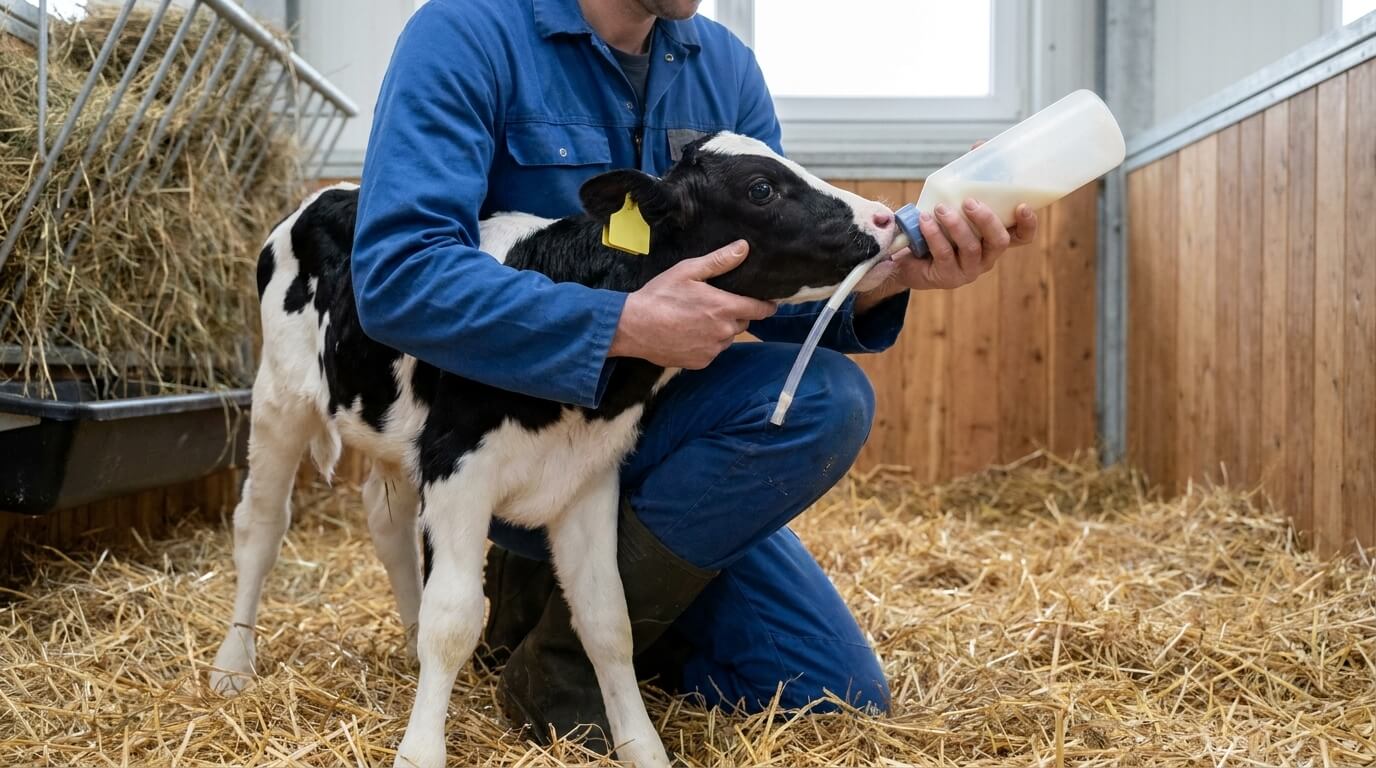
When do you choose the tube?
Always give the calf a chance to drink by itself first. When a calf sucks, the oesophageal groove closes. This is a kind of channel that guides the milk past the forestomachs straight to the abomasum. With a tube, the colostrum goes into the forestomachs first.
The tube becomes an option when:
- the calf does not drink, or drinks too little, from the bottle after a few calm attempts;
- the calf is weak after a difficult birth;
- the calf is cold and shows little suckling reflex;
- you want to be sure the first portion of colostrum goes in on time.
In practice we see that a calf that was tube fed the first time often drinks from the bottle by itself at the next feeding. So try the bottle again first each time.
How much colostrum, and how soon?
The sooner the calf gets colostrum, the better it absorbs the antibodies. The advice from research is to give about 10 percent of birth weight within the first two hours after birth. For an average Holstein calf, that is around 4 litres.
Measure colostrum quality with a refractometer. A reading of 22 % Brix is good, 25 % is very good. If the colostrum is below 22 %, you can upgrade it with a colostrum supplement.
Warm the colostrum to body temperature in a warm water bath. Too hot is not good for the antibodies, too cold costs the calf extra energy.
How to tube feed a calf, step by step
- Get everything ready: a clean tube, lukewarm colostrum and a second person if possible.
- Position the calf well, standing or lying on its chest, with the head in a natural position. Do not lift the head high.
- Estimate the length. Hold the tube along the calf’s head and neck so you know roughly how far it needs to go in. Many tubes have a mark for this.
- Insert the tube. Open the mouth from the side, slide the tube over the tongue towards the back and wait for the calf to swallow. Then slide it further gently, without pushing.
- Check the position. Feel the left side of the neck. You should feel two tubes: the windpipe and the feeding tube in the oesophagus. If you cannot feel the tube, or the calf coughs, pull it back and start again.
- Let the colostrum flow. Hold the bag or bottle above the calf and let the colostrum run in by gravity. Do not squeeze hard, so the calf has time.
- Remove the tube gently. Kink or pinch the tube closed before you pull it out. That way no colostrum drips into the throat, where the calf could choke on it.
If a calf cannot swallow or is lying flat on its side, do not tube feed it and talk to your vet.
Cleaning after use
A dirty tube carries bacteria into the calf. After each use, rinse the tube first with cold water so the proteins do not stick. Then wash it with warm water and soap and hang it up open to dry. It helps to keep a separate tube for calves that are not fit, so you do not mix them up.
One bottle for drinking and tube feeding
A bottle that takes both a teat and a tube is practical. The Speedy Feeder and the Speedy Drencher are the same bottle, only the cap is different. You offer the teat first, and only change the cap if the calf does not drink. That way you do not need to pour the colostrum over.
Read more about the first hours after birth in our articles on colostrum management in the category Calves.
Frequently asked questions
How do I know for sure the tube is in the oesophagus?
Feel the left side of the neck. Next to the firm windpipe, you feel the tube as a second pipe. If the calf coughs or you feel only one pipe, pull the tube back.
Is tube feeding worse than the bottle?
The bottle is preferred when the calf drinks well, because the colostrum then reaches the abomasum through the oesophageal groove. If the calf does not drink enough, tube feeding is better than too little or too late colostrum.
How fast should the colostrum flow in?
Let the colostrum run in by gravity and do not squeeze the bag or bottle hard. A slow flow gives the calf time.
Should I tube feed every calf as a routine?
No. Offer the bottle first. Tube feeding is a tool for calves that do not drink, or drink too little, by themselves.
How often should I replace a tube?
Replace the tube when it is rough, cracked or discoloured. A damaged tube is hard to clean and can injure the calf’s throat.
Sources
- Godden SM, Lombard JE, Woolums AR (2019). Colostrum management for dairy calves. Veterinary Clinics of North America: Food Animal Practice 35(3): 535-556.
- Topro knowledge base: Colostrum management; for the right start!
- Topro knowledge base: Managing colostrum; important?
Recommended products

Necessities · Cattle
The Feeding tube Kruuse has been specially developed for entering solutions into calves. The tube is easy to fill with the zipper and can be operated by one person.
€32,95 excl. VAT (21%)


Necessities · Cattle
The 0-32% brix refractometer from a.s is a colostrum measurement device to accurately and quickly test the quality of colostrum. The concentration of antibodies (immunoglobulins) in colostrum is vital for…
€33,02 excl. VAT (21%)

Necessities · Calves
The calf probe Speedy Drencher is a handy drench bottle for feeding young calves. The wide opening makes the bottle easy to fill and clean. The dosage is easy to…
€37,30 excl. VAT (21%)

 EN
 NL