 EN
 NL

Guide · Energy
The advantages of drenching
There are many advantages of drenching. Drenching, the oral application of an adequate amount of liquids, is extremely suitable for sick cows,…


In short
The largest forestomach of cattle, where microbes ferment grass and forage into usable energy.
Cattle have a stomach with four compartments. Three of them are forestomachs: the rumen, reticulum and omasum. Only the fourth, the abomasum, corresponds to the human stomach. The rumen is by far the largest part. In an adult dairy cow it holds 150 to 200 litres and fills almost the whole left half of the abdomen.
Billions of bacteria, fungi and protozoa live in the rumen. They ferment the feed, above all the cellulose from grass, silage and straw. Without these microbes the cow could make little use of forage.
The cow eats quickly and swallows her feed roughly chewed. In the rumen it is mixed, soaked and later brought back up for rumination. While ruminating, the cow breaks down the fibres and produces a lot of saliva. A healthy cow ruminates for around eight hours a day.
The microbes break down the carbohydrates into volatile fatty acids:
These fatty acids pass directly into the blood through the rumen papillae. The microbes themselves move on with the digesta and are digested in the intestine as high-quality protein. So the cow really feeds her rumen microbes, and the microbes feed the cow.
Fermentation produces acids. Saliva buffers them with bicarbonate, and a cow produces well over 100 litres of saliva a day. Normal rumen pH lies between about 6.0 and 6.8. A lot of rapidly digestible starch and little structure lower it. If it drops below 5.8 for several hours a day, this is called subacute ruminal acidosis (SARA). The fibre-digesting bacteria suffer most, feed efficiency drops and milk fat content falls.
A newborn calf functions as a monogastric animal. Milk flows through the oesophageal groove past the rumen straight into the abomasum. The rumen is small and has hardly any microbes yet. It only develops once the calf takes in calf starter, hay and water. Concentrate supplies the butyric acid for the growth of the rumen papillae, and forage trains the muscles.
In the past this led to early weaning and plenty of forage. Today it is clear that generous milk feeding in the first weeks raises later milk yield without slowing rumen development. You can read more in Metabolic programming of calves.
The basic rules are simple. Feed enough structured forage and mix the ration so that the cows cannot sort it. Build up concentrate slowly after calving and split it into several small portions. Make sure the cows always have free access to clean water.
A good look at the herd tells you a lot. At least half of the lying cows should be ruminating. Manure should be porridge-like with hardly any undigested fibre. A well-filled left flank shows that the cow has eaten enough. A milking robot or sensor collar gives you the rumination time per day directly.
Around calving the rumen is under extra pressure, because the ration changes and feed intake is low. Good rumen fill during this period lowers the risk of metabolic problems. You can read how drenching helps in The advantages of drenching.
In an adult dairy cow the rumen holds 150 to 200 litres. It fills almost the whole left half of the abdomen.
Normal is about 6.0 to 6.8. If the value stays below 5.8 for several hours a day, this is called subacute ruminal acidosis.
The rumen develops as soon as the calf takes in calf starter, hay and water. By weaning it should be developed enough for the calf to live on solid feed.
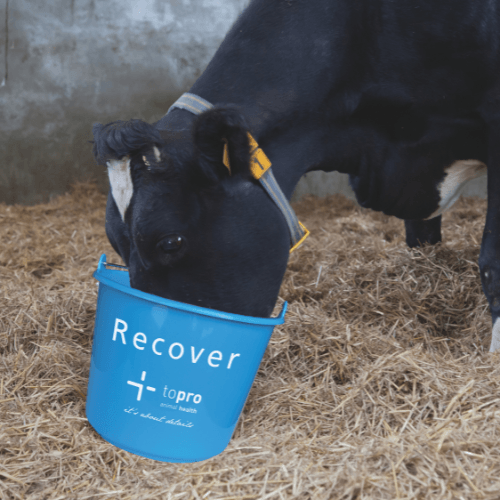
There are many advantages of drenching. Drenching, the oral application of an adequate amount of liquids, is extremely suitable for sick cows,…
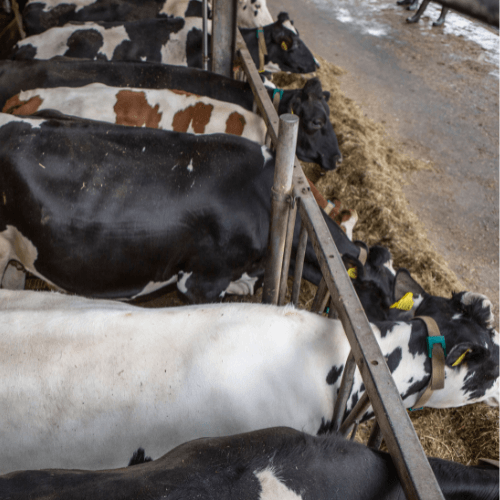
Rumination looks like calm behaviour, but it is actually a quick check of rumen health. During rumination, feed particles are broken down…
The transition period is the moment when energy supply is under pressure: milk production gets going, hormones fluctuate, and at the…
Discover our new magazine “Farming Forward”, formerly known as “Cow Programme”. We have also added topics such as hoof care, hygiene and daily farm supplies.
Read the magazine

Cart

Your cart is empty.