 EN
 NL
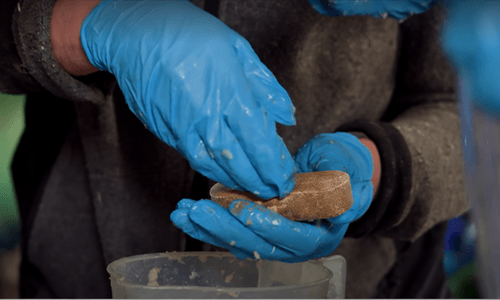
Guide · Udder
Make a garlic bolus yourself or buy one ready-made? The differences at a glance
Almost every month, a few hundred dairy farmers in Germany search for "make a garlic bolus yourself". The question makes sense. Garlic…


At a glance
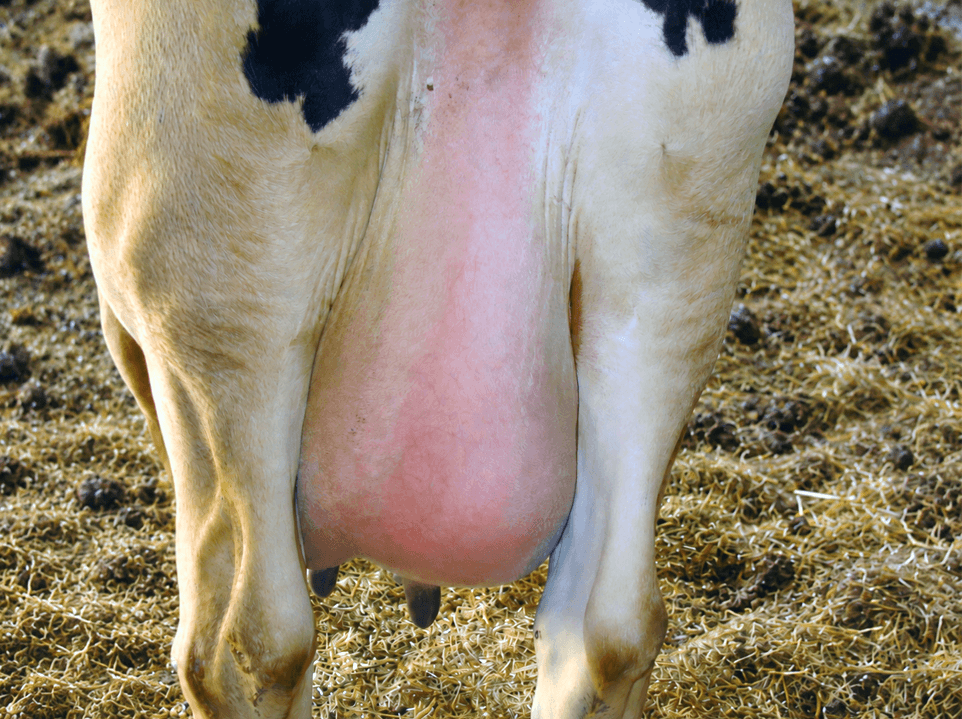
A heifer whose udder stands tight and shiny a week before calving, with a thick ridge of fluid in front of the udder and sometimes reaching the navel: that is udder oedema. A mild form is normal and disappears by itself after calving. A severe form is painful, makes milking harder, damages the teats and increases the risk of mastitis. This article explains how udder oedema develops, how to tell it apart from mastitis and what you can do in the dry period and after calving.
Udder oedema is a build-up of fluid in the udder tissue and in the skin around the udder. It is not an inflammation. In the last weeks of pregnancy the udder prepares for lactation: the blood supply rises sharply, while the outflow through veins and lymph vessels is squeezed, by the growing udder itself and by the pressure of the calf in the belly. Fluid leaks out of the capillaries and stays in the tissue.
Heifers are affected more often than older cows, because their udder tissue is growing for the first time and the outflow has not yet “settled in”. In a normal heifer the oedema goes down in the first 1 to 2 weeks after calving.
For comparison, mastitis: it usually sits in one quarter, feels hot and painful, and the milk shows flakes or is watery. If in doubt: strip the first milk and do a California Mastitis Test (CMT). How else to recognise mastitis is explained in Recognising mastitis in cows.
When is it too much? When the oedema reaches back to the thighs or up to the navel, when the teats are so tight that the milking cluster does not attach properly, when the cow walks badly or lies down, or when it does not decrease after two weeks. Then it becomes a risk for the suspensory apparatus of the udder and for the teat ends. If the cow is down after calving, something else may also be behind it: Why won’t my cow get up?
Part of it is physiology and genetics. The severe cases, however, are almost always linked to the ration and body condition in the dry period:
The goal: remove fluid and protect the teats until the oedema goes down.
Milk more often. Milking three times a day after calving, or milking the heifer out an extra time in the first days, takes pressure off the udder. With a robot: temporarily set a higher milking frequency for fresh heifers.
Massage with a cooling ointment. An udder ointment based on peppermint cools and supports blood flow and lymph drainage. Massage it in two to three times a day, from the teats upwards towards the belly. The udder becomes more supple and the milking cluster attaches more easily.
Exercise. Let the fresh heifer into the herd or out to pasture as soon as possible. Walking pumps away lymph.
Remove salt. No lick block in the calving pen and no extra sodium in the first days.
Vet. In very severe oedema the vet can give a diuretic. This is only needed when the cow is in pain, walks badly or the teats are getting damaged. A corticosteroid is sometimes used, but it suppresses milk production and the immune defence and is therefore not the first choice.
In a heifer usually 1 to 2 weeks after calving. If it is still there after three weeks, or if it comes back in an older cow every lactation, have the ration and the mineral supply checked.
Not directly, but the risk increases. Tight, damaged teats close poorly, the milking cluster slips, and the cow lets down her milk less well. Bacteria can enter through all three routes. In these weeks it pays to take special care with dipping and dry cubicles.
No. Oedema is not an infection. A garlic bolus is meant to support the immune defence when the cell count rises. With oedema the aim is to remove fluid: milking, massaging, exercise and adjusting the ration.
Almost every month, a few hundred dairy farmers in Germany search for "make a garlic bolus yourself". The question makes sense. Garlic…
A bulk tank cell count that climbs from 150,000 to 280,000. A milk recording report with eight cows above 250,000. Or an…
Mastitis is the most expensive disease on a dairy farm. A clinical case easily costs 300 to 500 euros through lost milk,…
Discover our new magazine “Farming Forward”, formerly known as “Cow Programme”. We have also added topics such as hoof care, hygiene and daily farm supplies.
Read the magazine

Cart

Your cart is empty.