EN
 NL


Hoof trimming in cows: procedure, intervals and common claw diseases
At a glance
- Lameness from claw diseases is the third most common cause of early culling.
- Housed cattle and sheep need 2-3 trims a year, suckler cows 1.
- Trim cows about 2 months before and 7 weeks after calving.
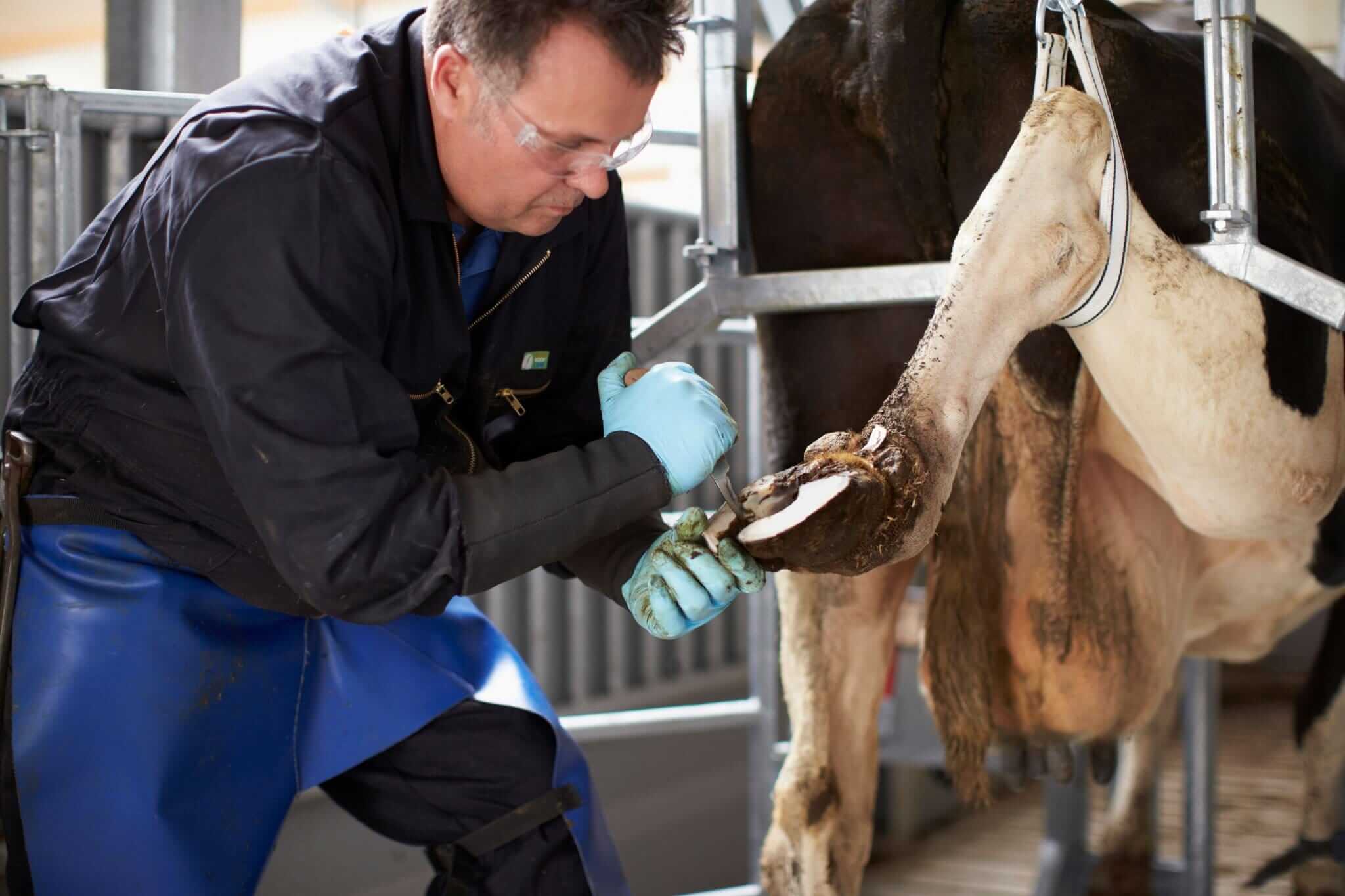
On dairy farms, lameness from claw diseases is the third most common reason for early culling [1]. Among sheep keepers in Hesse, 40 % name claw problems, alongside parasites, as their biggest problem [2]. Regular, functional hoof trimming keeps the load on the claw even and shows problems before the cow goes lame.
What is functional hoof trimming?
Functional hoof trimming brings the claw back into a shape in which both claws of a pair carry the load evenly. Most hoof trimmers work with the Dutch method in five steps [3]:
- Bring the inner hind claw to length: in a full-grown Holstein cow the front wall is about 7.5 cm long and the sole at the toe about 5-7 mm thick.
- Match the outer claw to the inner claw: both claws should be the same height, so that the outer claw does not carry the whole load.
- Dish out the sole: the sole is cut out slightly towards the gap between the claws. This takes pressure off the spot where sole ulcers develop, and manure falls out more easily.
- Relieve the affected claw: if there is a lesion, the trimmer removes horn from the affected claw. If needed, a hoof block goes on the healthy claw.
- Remove loose horn: undermined horn and hard edges, for example with heel horn erosion, are cut away.
Steps 1 to 3 belong to every routine trim. Steps 4 and 5 are added when the trimmer finds something.
How often should cows be trimmed?
Housed cows should be trimmed at least twice, better three times a year. Two dates have proven themselves: around drying off, about 2 months before calving, and about 7 weeks after calving. No more than 4 months should pass until the next trim. Suckler cows on pasture usually need only one trim a year.
How often it is really needed depends on the floor. On soft ground and rubber mats, less horn wears away than on concrete. In practice we see that a fixed rhythm achieves more than one single big date a year.
Lame cows should not wait until the next routine trim. Watch how they walk when they go out: a cow that arches her back, takes short steps or spares a leg should go into the trimming crush soon.
Which claw diseases are most common?
Claw diseases can be divided into two groups. Infectious conditions start from the skin, non-infectious ones from the horn itself.
| Condition | What you see | Group |
|---|---|---|
| Mortellaro (digital dermatitis) | red, strawberry-like spot where skin meets horn, usually at the back between the heels, typical smell | infectious |
| Heel horn erosion (interdigital dermatitis) | inflamed skin between the claws, heel horn broken up with V-shaped cracks, foul smell | infectious |
| Foul in the foot (interdigital phlegmon) | sudden, severe lameness, swollen coronary band, skin in the gap broken open | infectious |
| Sole haemorrhage | yellow to red discolouration in the sole horn | non-infectious |
| Sole ulcer | hole in the sole at the typical spot, usually on the outer hind claw | non-infectious |
| White line disease | crack or hole in the junction between sole and wall | non-infectious |
Mortellaro
Mortellaro is the most common infectious claw disease in dairy cows. It was first described in Italy in 1974 [4]. It is mainly caused by treponemes, spiral-shaped bacteria that penetrate the skin [5]. The spot is painful, and the cow is reluctant to put weight on the heel. Mortellaro is graded in stages from M0 to M4; M4 is the chronic form. A herd is rarely rid of Mortellaro completely. The aim is to keep the infection pressure low: dry, clean walkways, a regular footbath and early treatment of individual cows. More on this in the Glossary: Mortellaro.
Heel horn erosion and foul in the foot
Heel horn erosion is an inflammation of the skin between the claws that often occurs together with Mortellaro. The heel horn becomes soft and broken up, which shifts the pressure in the claw. Good barn hygiene and a footbath lower the infection pressure; at trimming, the loose horn is removed.
Foul in the foot usually starts from a small injury in the gap, for example from stones or edges on the slatted floor. The cow suddenly goes very lame and often eats less. If there is fever or severe swelling, the vet should look at the cow.
Sole haemorrhage, sole ulcer and white line disease
These conditions develop in the horn. Common causes are long standing times, hard floors and little lying comfort. Feeding also affects horn quality, for example with rumen acidosis or mycotoxins in the feed. A sole haemorrhage is often the early stage of a sole ulcer.
At trimming, the pressure is taken off the affected spot, in the case of an ulcer or white line disease usually with a block on the healthy claw. Just as important is the question of why the horn is damaged: do the cows lie down enough, and is the ration right?
Footbath and hygiene in the barn
Moisture and manure soften the horn and are a good breeding ground for bacteria. What helps in daily work:
- Scrape walkways and slats often, so the claws stand as dry as possible.
- Set up and bed the cubicles so that the cows like to lie down, and for a long time. Every extra hour of standing puts strain on the claw.
- Use a footbath regularly. A walk-through bath should be long enough for every claw to dip in at least twice. Change the solution before it gets very dirty.
- Check new animals for Mortellaro before buying them in, because the disease comes into the herd with animals.
In summer on pasture the claws dry off better. How heat in the barn affects the claws is explained in our article Heat stress and claw health.
Feeding and horn quality
Healthy claw horn needs, among other things, biotin, zinc and copper. Whether the ration is right here is best discussed with your nutritionist. If you want to give individual cows extra, you can use a bolus with biotin and trace elements for the claws, see Boluses for claw health.
Hoof care in sheep and cattle compared
| Hoof care compared: sheep vs. cattle | ||
|---|---|---|
| Feature | Sheep | Cattle |
| Claw growth | approx. 5 mm/month | approx. 5–8 mm/month |
| Trimming frequency | 2-3x a year, sometimes up to 6x needed | Housed: 2-3x/year; suckler cows: at least 1x/year |
| Trimming intervals | Every 3–4 months, about 4–5 weeks before turnout to pasture | Approx. 2 months before and 7 weeks after calving, repeat after 4 months at the latest |
| Main tools |
|
|
What equipment do you need?
For the routine trim you need a safe trimming crush, sharp hoof knives and pliers and, for cattle, usually an angle grinder with a grinding disc. For relieving a claw there are hoof blocks made of wood, plastic or rubber and the matching hoof glue. Plastic or rubber blocks cushion better and are less slippery than wood. Everything for hoof care can be found under Hoof care.
Frequently asked questions
How often should cows be trimmed?
Housed cows at least twice, better three times a year. A trim about 2 months before calving and one about 7 weeks after has proven itself. Suckler cows on pasture usually need trimming only once a year.
How fast does a cow’s claw grow?
In cattle the claw horn grows about 5-8 mm a month, in sheep about 5 mm. How much wears away depends strongly on the floor. On soft ground the claw gets too long faster than on concrete.
Can I trim the claws myself?
Yes, with a safe trimming crush, sharp tools and practice. Many farms learn to trim in a course and still have the routine trim done by a hoof trimmer, who is faster and sees more cases. Many farmers do small corrections between the dates themselves.
When does a cow need a hoof block?
A block goes on the healthy claw when the other claw of the pair needs to be relieved, for example with a sole ulcer. It usually stays on for up to 4 weeks. Check whether it is still in place, and take it off by then at the latest.
What is the difference between Mortellaro and heel horn erosion?
Both are infections of the skin. Mortellaro shows as a red, painful spot where skin meets horn. With heel horn erosion, the skin between the claws is inflamed and the heel horn is broken up. Often both occur together.
Which claw diseases can be spotted during hoof trimming?
During trimming, sole haemorrhages, sole ulcers, white line lesions and Mortellaro are noticed early. That is why the regular trim is also a check of the whole herd.
Sources
- Zijlstra J. et al. (2013)
- Wehrend A. et al. (2022)
- Toussaint Raven E. (1989): Cattle Footcare and Claw Trimming. Farming Press, Ipswich.
- Cheli R., Mortellaro C. (1974): La dermatite digitale del bovino. Proceedings of the 8th International Conference on Diseases of Cattle, Milan.
- Evans N. J., Murray R. D., Carter S. D. (2016): Bovine digital dermatitis: current concepts from laboratory to farm. The Veterinary Journal 211, 3-13.
Farming Forward magazine
Discover our new magazine “Farming Forward”, formerly known as “Cow Programme”. We have also added topics such as hoof care, hygiene and daily farm supplies.
Read the magazine